Monthly Archives: March 2016

From One Sentence to a Full Manuscript: How Novels are Born – Annie Whitehead

Today i open my blog to Annie Whitehead! author of the amazing To Be a Queen and Alvar the Kingmaker. Both books I’ve recently reviewed and enjoyed immensely  🙂

Thanks Annie.. myself and my readers appreciate you taking the time to be here with us.

My blog is all yours…

IMG_20160321_113455

Apart from the odd foray into fantasy fiction (Fattypuffs and Thinifers by André Maurois – although I notice now that apart from it being incredibly non-PC, it has historical costumes) I only ever read historical fiction when I was a child. I wasn’t a quick or voracious reader, so I really think it was the tales of history being brought to life which appealed to me, rather than the literature. But I also wrote my own stories (about Ferdinand the Hedgehog!) so I guess the desire to write was always there, and at some point the desire to write, and the desire to write history, coincided.

While history remained my first love, the literature thing continued to burgeon – I studied both subjects for ‘A’ level and was all set to read English at university when I switched and read history instead. My first two historical novels both came about because of a single sentence. In the case of To Be a Queen, the story of Alfred the Great’s daughter Aethelflaed, it was a sentence about her husband. My tutor said of Ethelred of Mercia that “Nobody knew exactly where he came from.” I suddenly had a vision of this guy riding onto the pages of history out of some unknown hinterland. I wanted to write his story and, in a way, I have. Although of course the real story was that of his wife: daughter of a king, wife of a man with the powers of a king (albeit a sub-king); a woman who led her army into battle against the Vikings.

Queen promo

My second novel was born when I read a paper written by that same tutor. It was about Aelfhere, earl of Mercia in the 10th century, and in a little footnote there was mention of a widow who had been deprived of her lands following his death. It’s the only known reference to this woman and the supposition is that she was Aelfhere’s wife. Hmm… Why did we not know more about her? This became part, although not the whole, of the story in Alvar the Kingmaker. A central theme, yes, but there was more which needed to be told. I wanted to write his story, but never as a thesis, or a non-fiction book. I suppose I wanted the element of ‘romance’, in its broadest term.

Alvarpromo

So how does one go about constructing an historical novel?

I had my ambition to write. I had my stories. And I knew my stuff. Ask me the names of any king between AD600 – 1066  and I could oblige. Ask me who invaded whose lands at any given period and why, and I could tell you.

Just one problem. I quickly discovered that I didn’t know how people lived; what they ate for breakfast, what they wore, how they built their houses and ships, which animals they reared and what type of crops they farmed.

It’s all very well having a chapter plan but not so great if you can’t actually describe what’s happening in every scene. I learned that knowing about history and having the information required to write an historical novel are not the same thing. Turns out that it was the literature, as well as the history, that had made those stories so interesting for me when I was young.

I also learned that it’s sometimes better to write the story and then only stop when you need to look up some historical detail – it keeps it human and personal if you concentrate on your characters and story. I know I’m not the only author who will draft sentences like this: ‘The table was laid with plates of check seasonal foods’ or ‘The children were waist-deep in the river, fishing for check types of freshwater fish later.

Luckily for me, I had contacts within the ‘industry’ who were more than happy to help, or knew someone who could. I immersed myself in my early medieval world, finding out about looms, textiles, cooking methods, flour production, and I even learned how flammable flour dust can be (a fact which served me well in one particular passage in ‘Queen’.)

Debby

But research isn’t the only thing required: you have to decide your story. It can’t simply be a narrative of what is known to have happened, otherwise it will read like an essay. But stray too far from the facts and you might as well just write pure fiction. Do you tell the whole of a person’s life, and end when they die, or do you focus on a particular period of history? Yes, you have your timeline already worked out, but where along that line do you start and stop?

Sometimes there are gaps in that timeline, and that’s where the fun can be had. You wonder ‘What if?’ And if the answer is ‘Nobody knows’ then you’re free to let your imagination fly. Sometimes you then unearth a scrap of evidence that gives credence to your idea – what’s known in the trade as a  ‘Bingo’ moment.

You also need to make your characters out of the chronicles and mould them into people. Carefully. My characters are not the Anglo-Saxons of Middle Earth. They are not mystical, magical or mythical, but rather they are medieval. My stories don’t contain elves or monsters. The ‘Dark Ages’ covers a period of over 500 years. To lump all the Anglo-Saxons together would be like saying the Tudors were a lot like us.

Alvar lives in a period of relative peace. People have a breathing space between Viking attacks to find out who they are, what their values are. ‘England’ is a reality and yet still only a concept to many. It’s a Christian world where people cling to superstition, too. It’s important not to place modern values on your characters – they need to live and work in their own world. Aethelflaed is a strong-minded woman, yes, but in writing her, I needed to keep her firmly rooted in her early medieval environment. She’s a woman in a man’s world, but she’s not what we would recognise as a feminist.

A sense of place, a sense of time. For me, the art of writing an historical novel is a subtle blend, requiring equal measures of: the story, the characters, the history, and the details. When the blend is right, it should be possible to have the reader not just dip into it, but  become fully submerged without those precious parts separating at any point.

Thanks Annie!

To keep in touch with Annie check out her BlogTwitter, Facebook, or Annie’s Author page on Amazon.co.uk or Amazon.com 🙂

Murder In-Absentia by Assaph Mehr – Review

Title – Murder In-Absentia
Author – Assaph Mehr
Genre – Fantasy
Length – 306 Pages, Print Length
Publication – Oct 2015
My Rating – 5/5 Stars

Synopsis

A young man is found dead in his bed, with a look of extreme agony on his face and strange tattoos all over his body. His distraught senator father suspects foul play, and knows who to call on.

Enter Felix, a professional investigator. In the business of ferreting out dark information for his clients, Felix is neither a traditional detective nor a traditional magician – but something in between. Drawing on his experience of dealing with the shady elements of society and his aborted education in the magical arts, Felix dons his toga and sets out to discover the young man’s killers.

Murder in absentia is set in a fantasy world. The city of Egretia borrows elements from a thousand years of ancient Roman culture, from the founding of Rome to the late empire, mixed with a judicious amount of magic. This is a story of a cynical, hardboiled detective dealing with anything from daily life to the old forces roaming the world

This is a story of Togas, Daggers and Magic – it will appeal to lovers of urban fantasy, detective murder mysteries and ancient Rome.

Review

I thought this book was brilliant; it’s a murder/mystery book in a pure fantasy world drawing on themes from Roman culture and i have to thank the author for the chance to read/review the story.

I won’t lie.. I wasn’t sure if setting a murder mystery in a more historical time point would work.. but it did.

We follow Felix, he’s a private detective of sorts.. has his hands in a lot of things.. knows a lot of people.

His help has been requested to help find out what happened to a young boy who is found dead in some rather strange circumstances.

One of the best things about the book is that since it’s a fantasy novel the author has been able to had some magic into the mix.. so it’s not a clear cut murder as you might expect.

Throughout the book the author gives great insight into the character for Felix, how he knows what he does and why he’s involved in the business he is. The development of the main character definitely has me interested in future stories.

I won’t give away the plot but it’s well written and planned out. Lots of twists to keep you engaged and interested.

I’m a big fantasy fan and this book but a nice twist on the genre I’m used to reading and it was a very refreshing read that I must certainly want to follow up on.

Any fan of murder mysteries or detective novels should enjoy the historical twist on the usual tales.

Credit to the author, he’s left me with a need.. and he happily fills this need in his notes at the end of the book where he points out some other authors and tales a reader might be interested in reading. I will certainly be looking up these authors and will be adding Assaph Mehr to my “to watch” list.. eagerly awaiting the next Felix story.

Overall I couldn’t fault this book in any way, nothing felt wrong or out of place. The story flowed well and was highly intoxicating.. I was compelled to finish the story.. I had to find out how things played out.
The good news is that it looks like more tales are planned and being set in a fantasy world it leaves the door open to so many possibilities for stories… can’t wait.

To find out more head to Goodreads, Amazon.co.uk or Amazon.com

Gordon Doherty on Writing and his Latest Project

Today I open my blog to the brilliant Gordon Doherty! I won’t lie.. i was pretty happy when he agreed to a guest post 🙂 Enjoy

Take it away Gordon….

The Time Machine

Everyone has a favourite yarn. H.G. Wells’ The Time Machine is probably mine. It evokes a sense of wonder, adventure, exhilaration and melancholy all at once. Imagine the possibilities and the untold knowledge that could be had if such a device existed. Writing, for me, is the closest thing to having a time machine of my own: it takes me a few steps further than reading or imagination alone. It’s the only place I can truly lose myself.

The first time I threw myself fully into the literary time machine I travelled back to the 4th century AD. This was a tale that was later to take shape as ‘Legionary’, the first volume in the eponymous series. Back then, I had lots of time, moderate expectations and a readership of zero. So I spent nearly six years reading and shaping my understanding of the world of the XI Claudia Legion and their stamping ground in the late Eastern Roman Empire. Although there were a few historical bloopers in there, by the time I published the first edition in 2011, I had a pretty solid grasp of the time period.

For my second novel, ‘Strategos: Born in the Borderlands’, I hopped into the time machine once more, travelled to the 11th century AD and delved into the mystical world that was apogee-era Byzantium. Now that was a mix of new ground and old. Byzantium was a direct continuation of the Eastern Roman Empire, after all, but by the 11th century it had morphed into something quite unique: blending elements of its western, Latin heritage with its Greek present, its emperors dressing in attire more suited to Persian kings and its people unwavering in their worship of the Christian God. Equally, while the political landscape had changed between the 4th century of Legionary and the 11th century of Strategos, both tales were set in and around the city of Constantinople, and across the countryside of Anatolia (modern Turkey) and Thracia (modern Bulgaria). So, different as Byzantium was, writing the tale of Strategos felt as if I was expanding on my solid Eastern Roman foundations.

That was five years ago. Since then I have stuck faithfully to the two series. Late Rome and apogee Byzantium have been my ‘thing’. Now, however, I have come to a crossroads that I always knew awaited me. The Strategos trilogy is complete and the Legionary series has reached a brief interlude at the end of ‘act 1’ (five books so far). What next? Another Roman tale? Well I am midway through a Roman-era trilogy with my good friend, Simon Turney – watch this space for news on that – but that only takes up a small portion of my writing time.

But what’s my next solo project? Well, the time machine has been nagging me for a long while to take it somewhere – or rather sometime – different. Sometime far more ancient than the world of the Byzantines or the Romans.

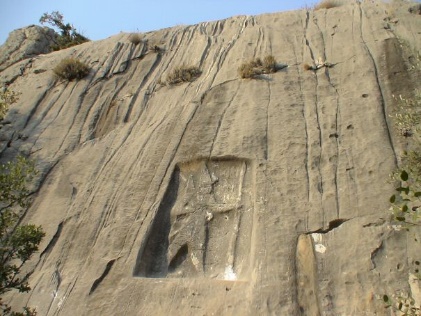
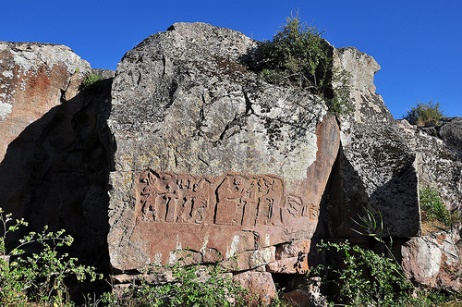
I once read an old text chronicling the history of Anatolia. It spoke of ancient, misunderstood carvings and reliefs on the mountainsides and bluffs of Turkey, mighty stelai telling of a once-great power, lost in the fog of history. The Greek historian Herodotus thought some of these reliefs had been carved by a conquering Bronze Age Egyptian Pharaoh who had marched into and claimed Anatolia…

…he was wrong.

The Karabel Pass in western Turkey. Herodotus mistook the relief to be that of an Egyptian Pharaoh.
3

The Fraktin relief in southern Turkey.
4

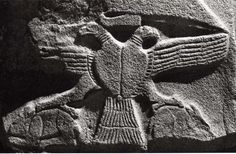
The Haga emblem, emblazoned on the gates of Arinna, a city in north-central Anatolia. It was such a relief that Apion first saw when riding through Chaldia in Mansur’s wagon in Strategos.
5

In Search of the Lost King

These markings are an echo from the Bronze Age, when the flame of antiquity was but young and bright, an age when Great Kings ruled the known world. Indeed, the rulers of Egypt, Assyria and Babylonia were gods incarnate. It is only in the last century or so that we have come to understand that these three divinely-appointed kings were not alone… for there was a fourth – a Great King who ruled Anatolia and whose artisans decorated his realm with reliefs like those above. His kingdom was known as the Land of the Hatti.

Together with the panoply of vassal states on its periphery, we know it as the Empire of the Hittites.

6.png

1260 BC. The powers of the near east in the late Bronze Age. Note that the term ‘Hittite Empire’ is a debate in itself. The Hittites actually called their realm ‘The Land of Hatti’, and referred to themselves as ‘The People of the Land of Hatti’. The term ‘Hittite’ comes from the Hebrew Bible, which refers to a group of relatively insignificant tribes living in the hills of Syria during biblical times – long after the fall of the Bronze Age. Modern Archaeologists, realising that these biblical tribes were the fragmented remnant of ‘The People of the Land of Hatti’, thus took to using the term ‘Hittite’ to refer to the Bronze Age superpower as well.

And as for the Hittite Empire? It was not an empire in the modern sense, more a proto-empire: a kingdom that enjoyed a loose hegemony over a band of vassal states around its borders. So in my story, I could refer to ‘The Hittite Empire’, or ‘The Proto-Empire of the People of the Land of Hatti’. I think I know which I will use 😉

Also note that Babylonia – absent from this map – had by this time been conquered by its more-powerful Assyrian neighbour (the southern end of the Assyrian domain roughly corresponds to ancient Babylonia).

And you will notice the land of ‘Ahhiyawa’ in the west, roughly equitable with modern-day Greece. Was this the land of Homer’s ‘Achaeans’? Were they a fifth great power? One thing is for certain – they had a massive part to play in the cataclysm that was to come…

The Hittites – a Bronze Age Superpower

The Hittite King – chosen by the Storm God and the Sun Goddess who stood at the head of their diverse and abundant pantheon – would have scoffed at the notion of Egyptians even setting foot in his homeland, let alone carving a victory relief upon its sacred rock. The Hittite army enjoyed a fierce reputation and defended their heartlands with their lives. Mighty Troy was but a minor vassal on the western outskirts of the Hittite Empire, its fine walls dwarfed by those of the Hittite capital of Hattusa – a sprawling fortress-city set firmly upon a craggy hillside high up on the central Anatolian Plateau.

A reconstruction of Hattusa, capital city of the Hittite Empire for long periods of its history.
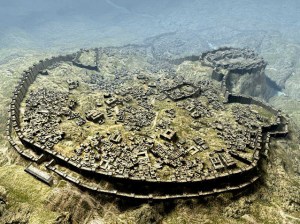
7

The site of Hattusa today, as seen from the west, with a reconstructed section of the lower town wall in the foreground and the craggy hillside upon which the city rested behind.

8

Finding the Hittites

You can probably tell from my excitable language in the last few paragraphs that I’ve already answered the time machine’s call. For the last few years I’ve been studying hard to understand the world of the Hittites. And in the last few months a first draft has been blossoming… and is now complete!

There is a long way to go yet before I have a finished novel, but the experience so far has been like a breath of fresh, Anatolian air. A new era, an untouched timeline of kings, wars, glory and ignominy; a whole host of characters rising from the historical sources: principled warriors, dark heroes, venal kings and shadowy courtiers.

Yet for all this promise, the sheer scale of the Hittite world and all they became involved in during the last centuries of the Bronze Age has proved to be very daunting and at times almost overwhelming. Indeed, the ‘step’ backwards into the Bronze Age itself has proved to be a massive leap. It has demonstrated to me how much I have learned about the Roman and Byzantine eras, for at almost every equivalent turn in my Hittite writings, I have met a cyclopean or mud-brick wall etched with a big, fat cuneiform question mark.

How did they say hello? Did they pave their roads? How did they organise their armies? What did they eat? How did they wipe their… well, you get the picture.

9The Hittite Army returning from battle with a long line of POWs (who are set to be put to work in the barren mills, fields and uplands of Anatolia).

The Hittite realm – sometimes called the land of 1000 gods – is a mist-veiled riddle. Their world is alien in comparison to that of the Greeks or Romans: the technology, the language, the customs and values, and their Gods (though Hesiod’s Theogony has many parallels with the Hittite myth of the Storm God’s beginnings). It’s been an absolute whopper of a learning curve, but I love learning (and I love curves? Er… move on!), even when it means trawling books and websites for hours to find the location of an old temple or fort ruin. And that’s the joy of it – ever the Indiana Jones wannabe, I see myself as an explorer at the edge of a dark jungle. I feel fear in my belly at the size of the task ahead and excitement coursing through my veins to think of what wonders might lie within. I refuse to dwell on the former and it’s a pleasure to seize the latter. It has been a privilege to learn, explore and conjure a tale along the way as I journey through the Hittite world.

Oh, and they raised a clenched fist to say hello or at least to salute/greet. They didn’t have paved roads. They organised their armies into divisions, subdivided into thousands (and they didn’t have cavalry – at least not in the sense we might recognise today). Amusingly/disgustingly, they made people eat poo and drink pee as punishment. Oh, and bestiality was punishable by death… unless it was with a horse, in which case it was absolutely fine. There is more, much, much more, but as usual, probably only 30% of the massive vault of facts and figures I’ve compiled will find a place in the story – as a reader I don’t appreciate books that try to shoehorn detail into an otherwise flowing story and I try to make sure I never make this mistake as a writer. That said, I’d never sidestep a thorough research stage: I’ve lost count of the number of times I’ve stopped writing because I’ve been posed a valid question mid-scene (e.g. did the Hittites use birthing stools?) and only had to leaf through my research doc to find the definitive, referenced answer. Off the cuff/on-demand research can work, but it can make progress somewhat jittery and unpredictable.
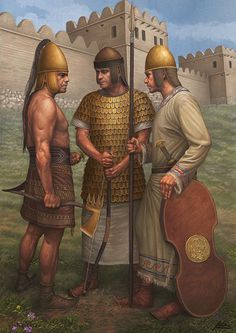
10

Hittite Warriors in discussion outside Hattusa’s mighty walls.

The Art of the First Draft

So how does one write a first draft? Well, some call it the ‘vomit-draft’, which is self-explanatory. I prefer the following analogy:

Gordon’s writing analogies #5617: Research and planning is like identifying a quarry site in the hills and selecting your chisels. The first draft is akin to hacking a big ugly chunk of limestone out of the hillside and dragging it down to your workshop.  The second and subsequent drafts and edits are where the artisan hews, sculpts and polishes the block, eventually producing a gleaming marble statue.

Putting the first sentence of my Hittite tale on the page was very, very difficult. Not because my mind was blank or short of ideas, but because I had a thousand different voices in my head, hectoring and squabbling over the how, where, when and why of that opening line. Yet I got there and it was like breaking the seal on a coffee jar. The first ten thousand or so words just spilled out of me after that, without much thought or doubt, other than to remember not to use the words steel or iron as much as I usually do!

Further along the line I hit some bumps and potholes. As usual, these came in the form of contradictions where one plot line made another impossible, or where I found a hole in my research that needed to be filled in. I stuck to usual practice when this happened: fixing the small issues there and then, but anything that was likely to take more than, say, ten minutes to fix, I’d just add a comment to the relevant section and move on. These comments then serve as a task list to be looked at after the first draft is done (indeed, that’s my next job!).

Some bumps are bigger than others. I was assaulted by a ‘fact-bomb’ just last week: hours after writing the final few lines of the first draft’s concluding chapter, I found a PDF excerpt from an academic paper that summarised the life of my main character and it proudly and smugly (okay, maybe not smugly) asserted that he was born 14 years AFTER my estimate of his birth date. And, as sod and his cursed legal code would have it, my book focuses on the first 14 years of the character’s life… 14 years of events rendered irrelevant to the character by the sneering, triumphant PDF. I’ll fix things though, by reworking the plot (AKA open-heart surgery, which has to happen at least once per book). And I’ll get my revenge on the PDF (by disabling Adobe updates – ha!).

When it comes to character-development, slipping into a pair of Hittite boots (leather, toes upturned) with this first draft has been a reinvigorating experience. I’ve ‘walked’ the ancient Anatolian routes and ‘seen’ that long-gone world through the eyes of the people who will live again in my tale. This, being the first book in a new series, puts me in the unfamiliar situation of having characters not neck-deep in effluent from the previous volume and needing to find a way out. My job, therefore, is to get them into the crap as soon as possible (and when you read the prologue, you’ll see I waste no time in doing so). Some of the characters have played out as planned, but not many. As usual, some of them blurt something out unexpectedly: loyal friends become dark-eyed and jealous; brave warriors suddenly find their guts turning to water, and cool-blooded generals make hot-headed judgements, only to suddenly find themselves in the jaws of disaster.
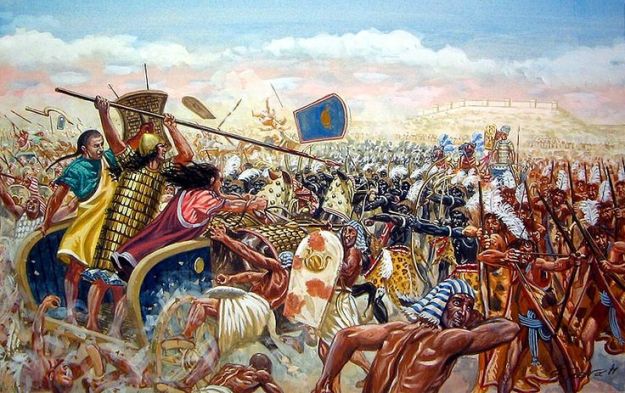
10The thick of battle: a Hittite chariot crew of a driver, a warrior and a shield-bearer.

Watch This Space

So, I hope that gives you a taste of things to come from me. I really hope this all comes together into a tale that readers out there can enjoy as much as my previous books. All being well, and assuming the time machine keeps running smoothly, I expect volume 1 of the new saga to be out in autumn this year. Watch this space for updates!

It’s been great talking with you, David. Thanks for having me.

www.gordondoherty.co.uk

Twitter: @gordondoherty

Facebook: Gordon Doherty

The Legionary Series:

The Strategos Trilogy:


Red Horse by M.J. Logue – Review

Title – Red Horse (An Uncivil War #1)
Author – M.J. Logue
Genre –  Historical Fiction
Length –  357 Pages (Print)
Publication – Jan 2015
My Rating – 5/5 Stars

Synopsis

September 1642, and the storm clouds of civil war are gathering over England. After the King raises his standard against his rebellious Parliament, idealistic young Luce Pettitt sees his duty clear – to defend the noble cause of freedom against the Royal tyrant. He doesn’t expect that duty to lie with possibly the scruffiest, most disreputable troop of cavalry in the Army of Parliament, commanded by maverick ex-mercenary Hollie Babbitt. Events conspire to bring Hollie and Luce to a wary friendship, in spite of their differences. But in the aftermath of the first bloody battle of the war, will Luce keep faith with his ideals, or his friend?

Review

So the English Civil War isn’t a period I’ve read about before but the cavalry have always fascinated me since I was young so when offered the chance to read this book in exchange for an honest review I jumped at the chance.

Now I’ve read a lot of books that contain war scenes and this book did something different to most.. the author decided to focus on the characters rather than the fight so the action moves quickly and you don’t get bogged down trying to imagine the field of battle. It makes for a smooth following story, rich in detail but just enough to give the story it’s realism.. The best detail in the book is left for the characters in my view.

The two main characters are Hollie and Luce. I won’t lie at first I just didn’t either of them.. they both came across as arrogant..they can only see things from their own perspective.. but you know there’s more to them and it compelled me to keep reading instead of going to bed at a reasonable time… I’m sure my wife loved the bedroom light being on at 2am 🙂

Both of these men a flawed, and brilliantly so. I won’t go into detail as I think it would take something away from the reader. My honest view is that these two work well together and to see them develop throughout the story, egged on by each other was just brilliant.

I loved Babbitt’s troop also, when they were around it helped break up all the Hollie and Luce scenes so kept things fresh for the reader. There is also a special bond throughout the book with man and beast which I just loved. You can’t help getting attached to animals and after reading the book I feel a little attached to Babbitt’s horse Tyburn myself

Some of the author’s best bits were when they showed a particular event from two perspectives. I couldn’t help but find myself smirking at how things can be seen differently.

This all felt like a very real tale, with rich detail that made it come alive. The two main characters worked and developed well off of each other and in all honesty I need more.. book 2 will be added to my TBR list very shortly.

This was a very refreshing read for me.. can’t wait to read more

To find out more head to Goodreads, Amazon.co.uk or Amazon.com

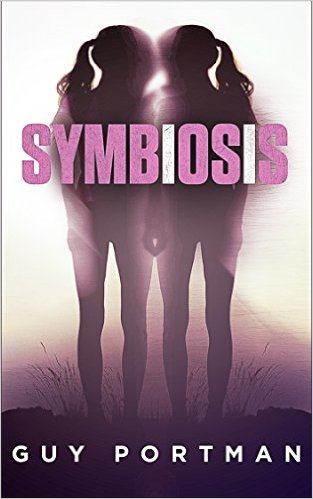
Symbiosis by Guy Portman – Review

Title – Symbiosis
Author – Guy Portman
Genre – Psychological
Length – 245 Pages
Publication – Jan 2016
My Rating – 3/5 Stars

Synopsis

Identical twins Talulah and Taliah have never been apart. Viewed as curiosities by children and adults alike, they coexist in an insular world with their own secret language. But being identical doesn’t necessarily mean being equal…

Soon a series of momentous events will send Talulah and Taliah spiralling out of control, setting them on a collision course with a society that views them as two parts of a whole. Will their symbiotic relationship survive?

Perceptive and poignant, Symbiosis explores our enduring fascination with twins and the complexities of twinship.

A valuable addition to the monozygotic canon…

Symbiosis demonstrates Portman’s ability to populate his worlds with peculiar yet plausible characters.

Moving and laconic, with impressive attention to psychological detail…

Review

This story follows the life of identical twins Talulah and Taliah. I must admit I was interested straight away since I myself have twins and always wonder if they will have a “special” connection. After reading the book I certainly still hope they do.. just not to the degree these twins do.

I’ve never read a story like this before and it was very interesting to read about the kind of symbiotic dependency the girls had with each other… at first you just felt the girls were misunderstood but as the story developed I found myself wondering about the mental health of Talulah in particular who seems to have a more parasitic effect on her sister.

The story flows well but I did find myself skim reading when the girls talked in their own language since I had absolutely no idea what they were saying.

I also found as I read the book I just didn’t like the twins but I think this was mainly due to the symbiotic relationship that developed throughout the story..I just wanted to separate the girls myself since as a reader we know what the girls are thinking..i just found Talulah’s dependency frustrating but this does make you think.. these connections people have.. their needs..it would be nice to have this type of connection with someone but as the book draws on you realise it’s not all it’s cracked up to be.

One thing the book did really well from my point of view was bringing up the subject of individuality.I know from experience that a lot of people refer to my two girls as “The Girls” or “The Twins”.. buy them the same clothes etc even though they are individuals. Don’t get me wrong.. at times it’s nice but at other times you really do like to see them as separate people. People don’t always get this and add in the fact Taliah & Talulah have major communication issues it’s easy to see how this strong of a connection could be made between them.

The whole tale is very psychological for me..in-depth and it does make you think what would happen if you were in this type of relationship where you didn’t feel you had your free will…

Very interesting indeed, and thank you to the author for the chance to read this book in exchange for an honest review.

I’d very much like to hear your views if you’ve read this yourself

To find out more information head to Goodreads, Amazon.co.uk or Amazon.com.

Fire & Steel (King’s Bane Book 1) by C.R. May – Review

28960877

Title – Fire & Steel (King’s Bane Book 1)
Author –  C.R. May
Genre –  Historical Fiction
Length –  355 Pages
Publication – March 2016
My Rating – 4/5 Stars

Synopsis

523 A.D. Arthur is dead.

As Britannia burns a small tribe clings to its colony of Anglia.

Across the German Sea powerful enemies covet Engeln itself.

But the English are not easily cowed.

As Spear-Danes threaten the homeland a hero returns,

leading the fightback with ferocity and guile…

Review

I always like to do a bit of research before I read a book from an author.. as in do they have any other books out etc and a quick look shows C.R. May has a few books under his belt with some very decent reviews so I was looking forward to what could promise to be a great series to get into.

I wasn’t disappointed at all, it’s a nonstop ride for Eofer and his loyal men… honestly the man never stops moving.

I really enjoyed the descriptiveness and the language used to weave this tale, it was a nice blend of words I’m familiar with whilst also engaging my brain with some words I’ve not come across before.. I like this in a book, hooks you in.. keeps your brain active.

Not much is given away by the synopsis but you can tell from that and the cover that war is afoot..and lots of it. Revenge is the word to describe this book.. every action has a reaction and it left me wondering what was coming next..and indeed left me wondering what more can happen in book 2.

I did feel at times the story jumped too fast.. at one stage our hero arrives home and sees his family but with the turn of the page he’s off again. It didn’t leave much chance for the characters to develop or for me to bond with them but the authors style of writing leads me to believe these characters develop long term.. not just over 1 book

From reading the authors notes I can tell some of these characters have appeared in previous books also which will spur me on to read his previous books to gain more perspective into these characters.

While I would have liked to see a bit more growth with a few characters I did however fall I love with a few of the others. There were two who stood out for me as the most interesting Grimwulf and Spearhafoc.. I hope they play a bit part in the next book

The storyline itself took me a few chapters to get into.. to understand who Eofer was.. but once things got going I was hooked. I’m never one for spoiling a story but look out for some awesome battlefield scenes being played out.

Overall this is a very strong book; decent storyline with some very good characters who I hope will develop throughout the series. It’s a fast paced, well written story full of blood and death. The author clearly knows his stuff and the historical note at the end of the book helps keep fact from fiction. Credit to the author, he’s left me with a taste for his work.. and I want more

The book is out now! to find out more head to Goodreads, Amazon.co.uk or Amazon.com

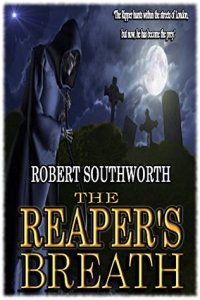
GIVEAWAY!!! – The Reaper’s Breath by Robert Southworth

Ok guys..today i bring to you a great chance to get your hands on a copy of the latest book from Robert Southworth!

29238904

Rob has very kindly offered up 2 copies!

For a chance to win 1 of these books either share this post on twitter or comment below. I’ll choose one person who tweets as well as one person who comments below to win.

Make sure i’m tagged in your tweet so i can see it 🙂

Open to UK residents, closing date is midnight Friday 18th March, winners drawn and announced on Saturday 19th.

If you want to remind yourself what the book is about then here’s the blurb –

Mary Kelly lies dead upon her bed… Her sorrowful eyes capture the agony of her fate. Anger, and fear walk side by side as the populace of London demand justice for the slain. William Harkness is a former officer of the 66th Regiment of Foot and he has entered the hunt. He will not bring a mad man to court, he is not tied by the laws of the land. William Harkness is the killer of killers, assassin of the evil…

You can also read my review here!

I rated it 5* and would love to hear your views.

If you’ve not been introduced to Rob’s work yet you should definitely take part in this giveaway and while your at it check out his other books! Have a look at Robs Amazon author page

Alvar the Kingmaker by Annie Whitehead – Review

28943504

Title – Alvar the Kingmaker
Author – Annie Whitehead
Genre – Historical Fiction
Length – 329 Pages
Publication – Feb 2016
My Rating – 5/5 Stars

Synopsis

In 10th Century England, nobleman Alvar knows that securing the throne for the young and worthy King Edgar will brand him as an oath-breaker. As a fighting man, he is indispensable to the new sovereign, but his success and power gain him deadly, murderous enemies amongst those who seek favour with the king. Alvar must fight to protect his lands, and his position, and learn the subtle art of politics. He must also, as a man of principle, keep secret his love for the wife of his trusted deputy. Civil war erupts, and Alvar once again finds himself the only man capable of setting a new king upon the throne of England, an act which comes at great personal cost. His career began with a dishonourable deed to help a good king; now he must be loyal to a new king, Aethelred, whom he knows will be weak, and whose supporters have been accused of regicide. Can he bring about peace, reconcile with his enemies, and find personal happiness, whilst all the time doing his duty to his loved ones? And what of the fragile Queen, who not only depends upon him but has fallen in love with him? Aelfhere (Alvar) of Mercia was known to the chroniclers as the “The blast of the mad wind from the Western territories” but also as “The glorious earl.” This is his story.

Review

I’ve been looking forward to reading this book ever since I finished To Be a Queen. While the books are standalone tales I very much recommend reading them both. Annie has a way of writing her female characters which makes these novels stand out for me.

For the main this book follows Alvar as he tries to guide the king as best he can with numerous things getting in his way… mainly the church.

It’s another beautiful piece of work from the author who manages to make the pages cover alive with her descriptions of the surroundings and her way of describing death manages to humble the reader.

One of the things I liked the most about this book is once again Annie has managed to write a love story amongst all this war/hatred and backstabbing. It takes a while for Alvar to get to grips with the political game he’s forced into.

As mentioned I loved the female characters in this book, two stood out Kata & Alfreda.(although there were more). I won’t spoil the story but the author manages to show real strength within these two for different reasons and for me these two made the book what it is.

As far as historical accuracy goes Annie Whitehead takes a great approach, sticks to the facts when possible and uses her imagination where needed. The author handily gives the characters nicknames since most of the real names would be unpronounceable to most of us. I felt this gave the book a better flow as I would have been stuck every time a name popped up. All of these name changes along with any other liberties the author has taken are explained at the end of the book..this shows just how good of an author Annie is, The perfect mix of fact and fiction to showcase her talent.

This book is full to the brim of love & deceit.. it keeps you hooked wondering what else can happen.. Then when events play out your left with a lump in your throat. Real emotion from words set on paper is a wonderful thing.

I only wish we knew more about what happened to Alvar..

To find out more head to Amazon.co.uk, Amazon.com or Goodreads.

10 Questions With…… Robert Southworth

Today i bring to you a interview with the talented Robert Southworth who is largely responsible for my love in books, After reading the first book in his Spartacus series i was hooked!

Rob very kindly agreed t answer a few of my questions 🙂

Q1 – How long have you been a writer and what influenced you to first put pen to paper?

In my heart I have always been a writer, like many would-be authors I spent many years
jotting down ideas or writing the first chapter of a novel I was determined to finish. However, I suppose it has been around 5 years now where I can actually call myself an author. It may sound silly but I still smile every time someone asks me what I do for a living.

Q2 – I’ve read all your books so far and you seem to find a story where many wouldn’t see any.. Which lead to a very unique story. Where do your ideas come from?

Partly through the interest in the subject matter, partly through wanting to be that little bit different. The rest is probably something close to insanity as the ideas arrived at the strangest of moments. In the middle night, changing my youngest son’s nappy…usually when a pen and paper aren’t available.

Q3 – With the new book you seemed to change your cover designs quite a few times. Some authors don’t seem to put much time into the designs. Do you think it’s important to get the cover image right?

It’s vital to me and part of the creative process. Unlike many authors, I only have a broad outline of the novel before I write it. So building the cover helps me visualise the world in which I want to immerse myself. The reason for a cover change is often because, as the story progresses so does my idea of what the novel is truly trying to say. It is also important to attract the readers but that is secondary in the process but still key to the production side of a novel.

Q4 – I’d be interested to know out of the novels you’ve wrote do you have a favourite?And if so why? I won’t lie… I love them all…

Tricky one, but for quality of work I think The Reaper’s Breath simply because I’m learning my craft and I think that this novel shows the improvement. However, two novels stand out for enjoyment in terms of writing Spartacus III because of the challenge of creating a book that was in essence one long battle scene. This was departure from my other books, where I usually try to keep action scenes to short punchy sequences. The other and probably my favourite overall is Wrath of the Furies. Virtually every character is from my imagination; it was my first attempt at a thriller and was a joy to write.

Q5 – Who have been your biggest influences/support within the writing community?

Oh lots, authors such as Lofting, Ashman, McKay, Bayliss, and Rule have all played major roles in supporting me in both the creative side and marketing. However, I have to mention Sajjad Tameez because without his support I would never have had the confidence to actually put my books out there.

Q6 – Are there any books/authors you’re looking forward to reading this year?

Ooo loads both Paula Lofting and Louise Rule should have new books out this year and I have been lucky enough to see snippets of both and they are going to be something else. On a sad note, I will miss the chance to buy Terry Pratchett’s books, a pure genius that will be missed by many.

Q7 – As well as being a writer I note you write reviews too. Is this something you enjoy?

Absolutely hate it…when it’s a book I don’t like, love it when it’s a book that I enjoy.

Q8 – How important is feedback from your readers?

It’s so important for very different reasons. Firstly, from a purely sales reason, good reviews and lots of them will spread the word and so you gain more readers. The second reason is even more important. I have yet to meet an author who isn’t plagued with self doubt. It is an affliction that seems to travel hand in hand with being an author and I am no different. To hear that someone enjoys your work fills me with joy and banishes self doubt…at least for a little time. I am lucky to have found readers who love my work and offer a great deal of support.

Q9 – Any plans for a sequel to Wrath of the Furies? .. I particularly liked that story 🙂

Yes… but not sure when. The sequel has been planned for some time, Hades Beckons centres on the kidnapping of an important Parthian official and his family, just as Emperor Hadrian is entering peace talks. I hope to begin the tale later in the year.

Q10 – Plans for the future? I’m sure we’d all like to know what idea you are working on

Interestingly it’s quite a tricky question. I have had a number of requests to turn my story telling to the early part of Spartacus’s life. I have actually outline a few idea’s and a three part series called Legend is in the preparation stage with the first book being called Born of Blood. I also want to continue the Ripper Legacies and do the follow up to the Wrath of Furies. If possible, and it is a big ‘if’ I would like to write The Reaper’s Touch, Born of Blood, and then Hades Beckons within the year. However, that would require a great shift in my work life balance, one which I cannot ensure. That said, I would definitely like to get at least two those books on the shelves before 2017.

Rob’s latest book is out now! Click here for my review of The Reaper’s Breath!

29238904

Click the image above to head to Amazon.co.uk to purchase your copy today!