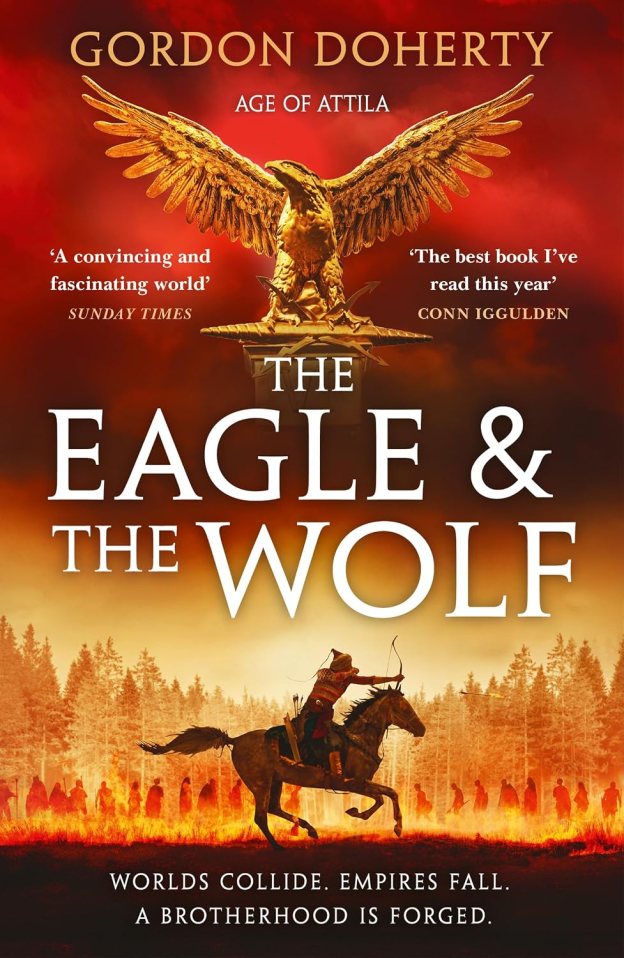
Today I’m reviewing The Eagle and the Wolf by Gordon Doherty
Here’s the blurb
Flavius Aetius, a noble Roman son, is an outsider in a savage land. He has been banished, given as hostage to the barbaric Huns and sent to the edge of the world.
What the Huns do not know, however, is that his father and mother have been murdered in a coup. He is an orphan, with no value at all. His life hangs on a lie.
In this new harsh world, he manages to find one grudging ally, a young boy named Attila.
A brotherhood is formed. One that, the shamans foretell, will shatter the world.
Review
When I heard Gordon Doherty had a new book out, with Attila the Hun it was a no brainer.. I had to grab a copy.
I’ll admit my knowledge of Attila is lacking, there wasn’t any lessons at school and I wasn’t a big reader as I kid but what I did know is he was the most well known Hun but also how the warriors were renowned for their ferocity and skill.
I’m always keen to learn more, but what I love about the historical fiction genre, and Gordon’s work in particular, is that he breathes life into history. He shows how fascinating the past can be while making these historical figures feel real. He makes you care about what happened to them rather than simply reading facts. It’s a real talent to bring such historical figures to life.
The book starts strongly as we see the beginnings of Attila, a weak, blue-lipped baby saved by his gods, his fate already sealed: to be the one who unites the Huns, the ruler of all.
We then meet Flavius, a young Roman whose life is uprooted during Roman power struggles. He’s forced into a wagon, his family dead or lost in the chaos of battle, without knowing why or what fate has in store for him.
He’s been betrayed, and so has his family. Those opening scenes really set the tone as we see the lengths some people will go to for position and fortune.
Flavius keeps hope alive, but the further away he gets, the more he understands that his fate is seemingly sealed. Still, he refuses to give up.
He’s been taken by the Huns as a means of security. Rome needs the Huns and their warriors. The problem is that the Huns don’t know how little Flavius actually means to Rome, and he must keep this secret or his life could be forfeit before he finds a way home.
There’s a major language barrier between him and the Huns, and I loved how the author worked around this, with a few central characters bridging the gap between them. None more so than Munzuk. At first, Flavius sees only savagery in the Huns, but Munzuk enables him to see the people they truly are.
Flavius must now find a way to survive among the Huns. With the help of Munzuk and Attila, he thrives, and there’s also a growing love interest which plays a pivotal role in the story and in the development of both Flavius and Attila.
There are internal battles within the Hun community too, and it was fascinating to see both the differences and similarities between them and their Roman counterparts. Both Flavius and Attila play their part and earn the respect of their peers.
The time comes when Rome sees fit to visit the Huns, and this time it’s Attila who is uprooted and taken to Rome to play his own part in the political games.
The time apart sees both men grow, and you can sense the danger that’s coming. The visions Munzuk had begin to come to pass as the men reunite, but there’s a growing sense of unease. They are still brothers, bonded through shared experiences, but the differences between them continue to grow. A figure from Flavius’s past only adds to the tension.
The climax of the book doesn’t disappoint. Battles and gore, love and loss, and the threat of even more pain and destruction to come.
For me, the flow worked so well as both men grow and develop their own sense of purpose. I loved how this was perfectly balanced with historical detail: how the Huns were at one with their horses, why Rome needed their help, and the political climate of the time, the games played that allowed some men to get away with actions that should have seen them trodden underfoot.
Two characters stood out to me Bonifacius and Ruga.. for very different reasons.. one I hated with a passion and one I grew to love.. Read the book and tell me if you felt the same.
What I always really look forward to are the author’s historical notes. Not only do they provide extra insight, but they also showcase the level of detail and research the author puts into his work, ensuring historical accuracy where possible while explaining where he has taken creative licence.
The best news is knowing that Book 2, Shield of Rome, is due out next August. I can’t wait.
A cracking 5-star read from one of, if not the, best historical fiction authors writing today. The plot is so wonderful weaved, and the characters so perfectly written, invested from the first page to the last!
To find out more head to Goodreads or Amazon, and do ask your local bookshop to get a copy in for you if they haven’t already 🙂

