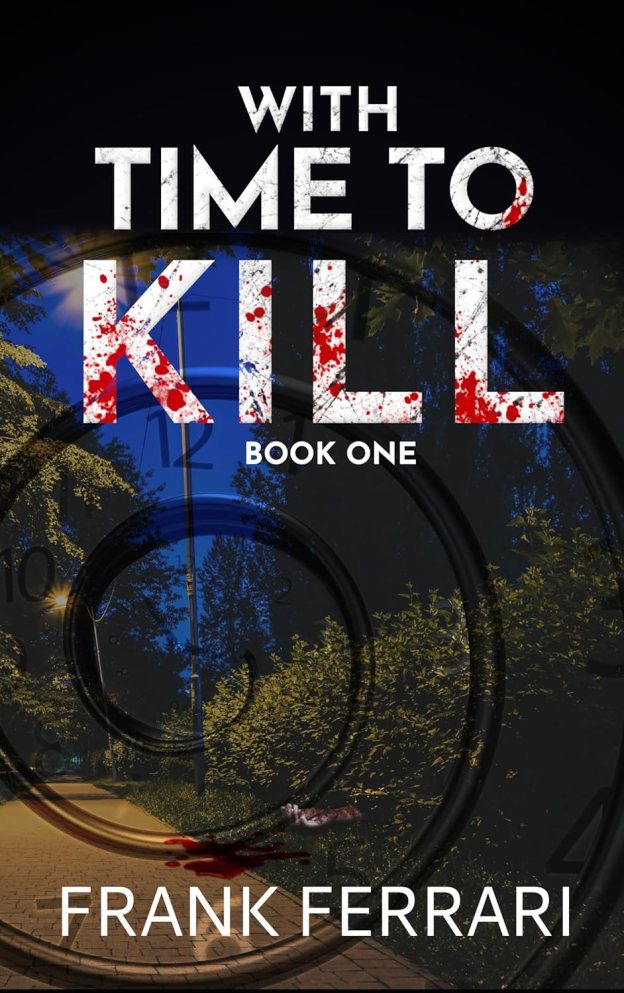
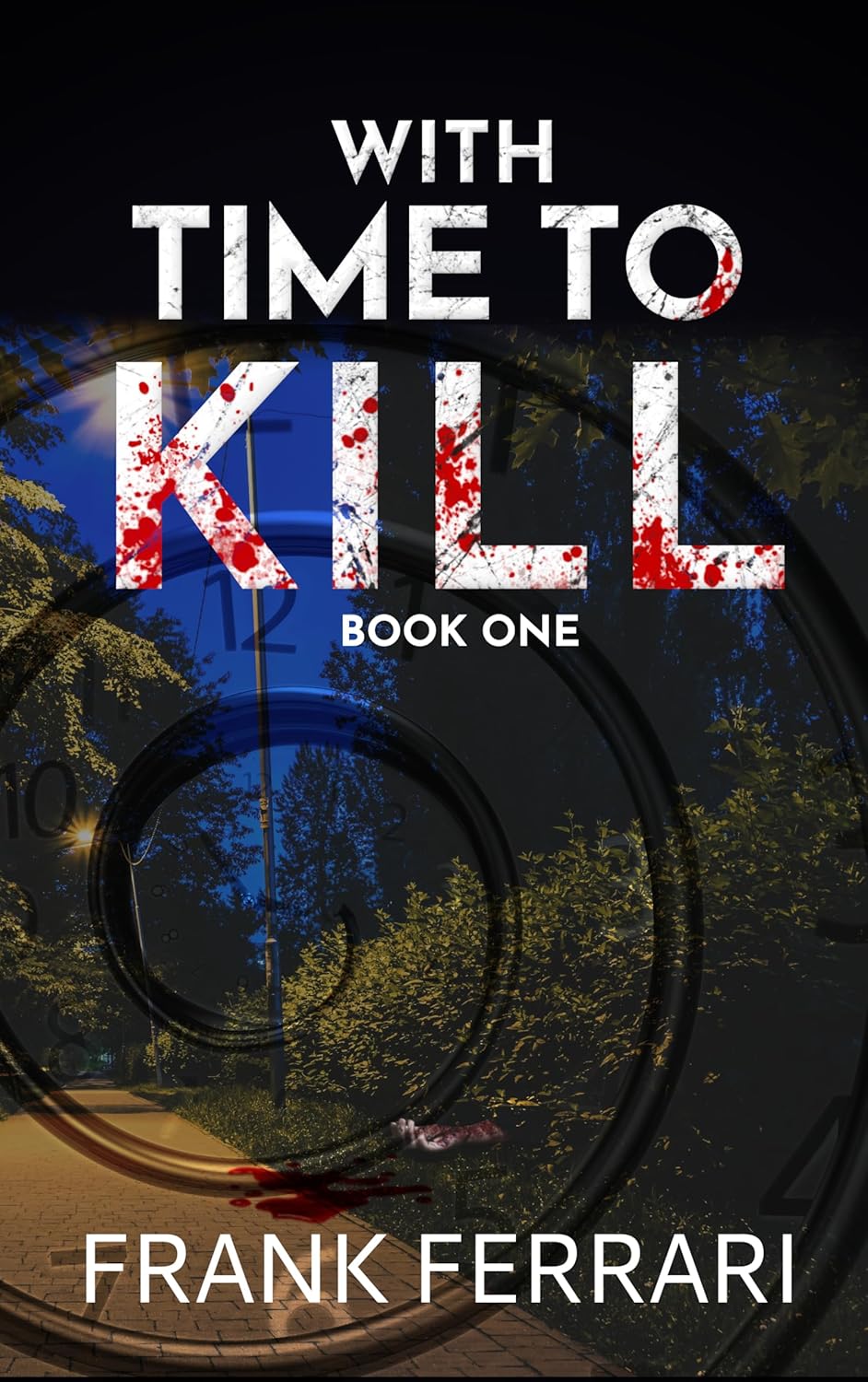
After reading With Time to Kill, (and loving it might I add!) I was very lucky to be given the chance to ask the author a few questions.
Firstly I’d like to thank Frank for taking the time to answer my questions, I still always get a buzz when an author agrees to one of these posts!
Without further ado I give you 10 questions with Frank Ferrari!
Q: What hit me first when reading With Time to Kill was how unique the story felt. Where did the inspiration for the series come from? You must like some science fiction yourself? My favourite even got a mention… I’m a massive Stargate fan. Did you find blending the genres together difficult or did it slot nicely?
Initially, With Time to Kill was supposed to be a short story about a guy who, after obtaining the ability to travel back in time, kills everybody who stood between him and his ambitions. He was going to be a corporate type (probably influenced by the environment I was working in back then!) and he was going to be very unlikeable. But I intended to make the story funny. I wanted it to be really dark humour, and the way the guy’s kills evolved was going to be ridiculous. For instance, I saw a scene in my mind in which his thirst for blood had reached such a high level that a person who jumped in front of him in the queue at Starbucks or Costa or something would become his victim.
As I say, it was supposed to be a short story – a little project to get me back into the swing of writing, having been away from it for a number of years.
Then, during a trip to the local supermarket with my wife, I spotted a guy perusing the flowers. A few days later, having forgotten to pick up something or other, my wife and I went back to that same supermarket, and there he was! The same guy checking out the flowers again. I don’t know who he was – have probably walked past him in the street several times since then – but what made me recognise him from one day to the other was his uniform: he was a local bus driver. In the car on the way home, I made a comment to my wife saying, ‘Imagine that guy has become obsessed with one of his passengers, and he’s trying to find the perfect bunch of flowers to leave at her doorstep…’
My wife literally shivered and said, ‘Ugh! That’s creepy!’
And that’s when I knew my story had to evolve. So, in essence, the inspiration was two ideas that came together to make something altogether different.
I really like science fiction – I was, once upon a time, a scientist myself! I lean more towards the works of Michael Crichton and Blake Crouch over the likes of Stargate and Babylon 5, however. In saying that, I thoroughly enjoyed Cixin Liu’s Remembrance of Earth’s Past trilogy (the first of which is The Three-Body Problem). I have never read such a vast, expansive story.
Blending the sci-fi element into what is essentially a Scottish crime tale just sort of happened! To begin with, I thought I was writing a science fiction story, but as I got to know the characters and I watched them develop, I knew the police had to get involved somehow.
Q. What has surprised you the most since becoming a published author? I know there’s hurdles along the way but has anything good really stood out?
It’s a lot harder than I realised it would be! Like countless others, I read everything I could find about publishing a novel. Eventually, I settled on the self-publishing route for With Time to Kill and its successors. Legend has it, unless you’ve got 25k followers, or your name is James Patterson, traditional publishers will leave the bulk of promotion up to the author, all the while taking a healthy slice of the royalties. I figured – as many before me have – that if I’m going to have to promote my books myself, I might as well keep as much of the royalties as I possibly can. Flipping the switch from storyteller to marketer/salesperson is very difficult, though. Despite having a decade’s experience in pharmaceutical sales and marketing, I have not yet mastered this side of publishing.
Q. What motivates you to keep writing? I mean, what keeps it exciting? Do you lock yourself away for hours at a time? How do you avoid any writing slumps?
I write full time and have done so since day one. I was made redundant from my previous career and took the opportunity to explore my lifelong dream of writing. That first day in which I didn’t need to go to the office, or log onto the company Teams account, I sat behind my desk at home at 8:30am and I started writing. I wrote like it was a full-time 40+ hour job, and I’ve done so ever since. Keeping that routine has helped me avoid any slumps (so far!). In terms of what keeps it exciting, that part’s easy: I love writing, and the way I do it (see my answer below!) keeps me hooked.
Q. It must take a while to flesh out your ideas/timeline? I was really struck by how well you humanised the characters.. Did you do many rewrites? Do you outline the story in full or let the story lead you?
I’m glad the characters in With Time to Kill resonated with you. I firmly believe the best stories are the ones driven by how you feel about the characters. Plot is fine, but if you don’t feel something about the characters, it just isn’t the same.
My writing process blends the two approaches (outlining, and being led by the story). I often have certain points or places where the story must go, but how we get there, and what occurs along the way, is all organic. That’s what keeps it exciting for me – often it’s like I’m discovering the story as a reader would at the same time as I’m writing it.
When the day’s writing is done, I go over it in my head while out with the dog or making dinner, then at night I think about what’s going to happen next as I drift off to sleep. That helps me hit the pages running the following day. Once the first draft is complete, I let it sit for a while – a few weeks at least – and I go do something else. When I come back to it, I read through, then give it a comprehensive rewrite, fixing plot holes or inconsistencies, etc. When that’s done, I pass the draft to my wife, and we both read it through. She comes back to me with points and suggestions that invariably make the story better, and I implement those. After another read through, it’s ready for the professional eyes of my editor. After another few weeks, I incorporate his comments and suggestions, and then – after a final full read – it’s ready for wider consumption.
Q. I know I’m new to the series (I’ll make amends for that quickly!!) Do you think your writing evolved over the course of the series? Did you learn any lessons along the way?
My writing has definitely evolved. The editor I work with now was not the one who worked on With Time to Kill, but I’ve since gone back and incorporated his teachings into it. He taught me many things. For example, anyone reading the With Time to Kill books will see there’s some humour in them. Sometimes, in the early drafts, the jokes didn’t sit well amongst the darker goings-on around the characters. That’s one thing I’ve learned to manage. It’s perfectly okay to be funny, but there’s a time and a place! Upon reading The Last Trip for Good (the final instalment of the With Time to Kill trilogy) my editor said: ‘the writing has come on in leaps and bounds since the first manuscript I saw’, which showed me how far I had come.
Q. Were there any messages you were trying to get across to the reader through your words? It’s a fascinating idea to think about what we would do if we had the power to influence the past.. Did you expect it to be as thought-provoking as it is?
As I started writing, I didn’t for one moment think I was going to come out with anything worthy of deep thought! I just wanted to write a story that, initially, was supposed to get me back into the groove. Later, it became an exercise in whether I could write a novel-length manuscript. As the story evolved, however, I found myself absorbed by the characters. What started as a pretty one-dimensional killer became a more complex, broken soul who, in order to realistically do the things he does, had to be the kind of person who could be nudged by outside influences. I became fascinated by Garry. He’s this morally blank canvas who, after a lifetime of loneliness, is suddenly caught between two opposing influences – one overwhelmingly ‘good’, and one very much not good! I suppose the question I wanted to answer was: what would drive somebody to kill in order to improve their life? With Time to Kill and its siblings is my answer!
Q. I can’t do one of these posts without asking you about how you feel about reviews? Do you take much notice?
I’m supposed to say: ‘Nah, I don’t pay attention to reviews. Reading is incredibly subjective, and one person’s five stars is another’s zero stars…’ but I’m human! Of course I notice, especially in these early days. Pleasantly, most reviews for my books have been positive, which is a massive confidence boost. If I had to pick a favourite Amazon review for With Time to Kill, it would have to be one from a lady in the US, who expected something very different… She wrote:
‘A psychological thriller that became part science fiction. I was so annoyed as I do not like sci-fi, I almost stopped reading. Glad I stuck with it. Turned into a fairly enjoyable read.’ And she gave it five stars! The fact that this avid psychological thriller reader was, in the end, convinced by a Scottish crime/sci-fi mash-up made me very happy indeed!
On top of that, seeing the feedback from people like yourself – and others with a similarly significant presence in the social book world – is very humbling. You, and others, have shown me that my books can stand shoulder-to-shoulder with those of more established writers, and that makes it all worthwhile.
Q. One of the things I find the hardest about loving books is there’s so much out there. How have you found promotion? Do you enjoy the whole social side?
Good promotion is the Holy Grail – everybody’s searching for it, but it’s the hardest thing to find. There’s also a danger with it: every writer gets bombarded with emails and messages from so-called ‘experts’ in book marketing, all promising to get your book ‘the attention it deserves’. For a price, of course. It’s all absolute nonsense, and any aspiring writer reading this should take heed: these people will take your money and give you nothing of value in return. The truth is: there is no magic bullet. There’s no one-size-fits-all solution. We just need to stay resilient and keep trying.
I haven’t been great at the social media side of things. My time always seems to be taken up by writing the next book, editing the previous one, studying with the Chartered Institute of Editing and Proofreading (CIEP) as I’m currently doing, all while learning how to be a dad! I need to invest more time into social media and I have a list of videos/posts that I want to create (one video series is going to be defining some of the more Scottish terms in the With Time to Kill trilogy for non-Scottish readers).
In addition, blogs like this one, where indie authors are given a fair chance, are so valuable – on behalf of writers everywhere, thank you!
Q: Do you read a lot yourself? If so, what have you been reading or what genre do you go to?
I read every day, right before bed. Always have done. I like lots of different genres and, as is the case with music, I tend to fall in love with a writer/artist rather than any particular genre. For instance, my favourite author is Stephen King, although I wouldn’t class myself as a ‘horror’ fan. I recently read his Dark Tower series for the third time, and loved it just as much as the first. I also read ‘Salem’s Lot for the first time not long ago. It’s out-and-out horror but, man, some of the writing in that novel is just beautiful!
I also recently read John Grisham’s The Guardians, Karin Slaughter’s This is Why We Lied, and I’m currently reading The 6:20 Man by David Baldacci (the first of his works I’ve read).
Other writers I really like are John Marrs (anything by him is well worth a read), Blake Crouch (he’s got grounded sci-fi down to an art), JD Kirk (a fellow Scot and master of crime fiction), Andrew Mayne (his Theo Cray/Jessica Blackwood books are brilliant), and I’m a real sucker for the dystopian classics – Margaret Atwood’s The Handmaid’s Tale, Ray Bradbury’s Fahrenheit 451, Aldous Huxley’s Brave New World, Yevgeny Zamyatin’s We, and of course George Orwell’s Nineteen Eighty-Four.
Q. I really need to know… What’s next? What can we expect to see from you?
A few weeks ago, I finished the first draft of my next novel, which is unrelated to the With Time to Kill trilogy. It’s a tale of found family and rebellion set amidst a bleak, totalitarian dystopia. It came from an idea that has been knocking around in my head for over a decade, but always felt too big for me to tackle. The first draft needs a lot of work, but I’m pleased with the story and it’s going to spawn more books – probably a trilogy or quadrilogy, we’ll see. I’m letting it sit for now while I complete my accreditation with the CIEP, but I hope to have news about later in the year.
As regards the With Time to Kill trilogy, the covers are getting a bit of a facelift/revamp, bringing them more in keeping with the Scottish crime genre, so watch this space!
About the author.
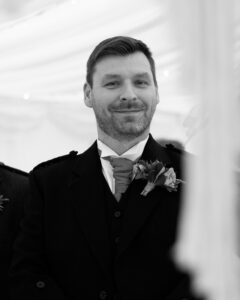
Frank Ferrari is a Scottish writer of speculative fiction, where science fiction collides with suspense and intrigue, and memorable characters lead you through dark, thrilling atmospheres. He is the author of With Time to Kill and its sequel The Dying of the Light, as well as Water of Sorrow, co-written with his late father.
Educated in science, Frank was a bench chemist, then spent over a decade working in the commercial pharmaceutical industry before returning to the passion that had gripped him as a child: writing stories. After years of short fiction, he turned to novel-writing during a difficult period in his life, finding therapy and purpose in the process. Out of that challenge, With Time to Kill was born.
Frank writes because he loves to read, and he seeks to offer readers the same escape and immersion that books have always given him. Originally from Perthshire and now living in the Borders – settings that feature in some of his novels – he finds inspiration in the landscapes around him. When not writing, he can often be found walking the hills and forests with his dog, or enjoying time with his wife and young daughter.
Want to know more about Frank and his books? Why not visit https://frankferrari.com/

