Tag Archives: Historical Fiction

1066 Turned Upside Down – Review

Title – 1066 Turned Upside Down
Author  – Joanna Courtney, Helen Hollick, Annie Whitehead, Anna Belfrage , Alison Morton, Carol McGrath, Eliza Redgold, GK Holloway, Richard Dee
Genre – Historical Fiction /Alternative History
Length –    197 Pages
Publication – 1st August 2016
My Rating – 5/5 Stars

Synopsis

Ever wondered what might have happened if William the Conqueror had been beaten at Hastings? Or if Harald Hardrada had won at Stamford Bridge? Or if Edward the Confessor had died with an heir ready to take his place? Then here is the perfect set of stories for you. ‘1066 Turned Upside Down’ explores a variety of ways in which the momentous year of 1066 could have played out differently.

Written by nine well-known authors to celebrate the 950th anniversary of the Battle of Hastings, the stories will take you on a journey through the wonderful ‘what ifs’ of England’s most famous year in history.        

Review

What a brilliant book this was. I just love the idea that the authors have taken a period in time and let their creative juices flow. 1066 is a fascinating period to read about and to have these authors explore the “what if” was refreshing

I’m a big fan of collections like this, I find then fun to read. Not only do they flow easily since they are self-contained short stories but you also get introduced to some authors you might not previously have heard of. I’ll admit I’ve only read books be three of these authors.. that will soon change.

The book starts with a forward by C.C Humphreys. I’m the first to admit I’ve never really understood the need for these in a book but this one has changed my mind. This forward was witty and fun and perfectly set up the book for me as a reader

Each author tackles at least one story, they each take an event that happened and twist it.. they explore the possibilities that might have occurred if things went differently.

After reading other books I’ve always wondered about the “what ifs” Such as what would have happened if Harold had waited before going to war on that fateful day.. what would have happened if the rest of Harold’s army had arrived in time to engage in the fight..the outcome could have been so different

One of my favourite stories had to be the tale by Richard Dee, the perfect mix of science fiction and historical fiction, where the butterfly effect is explored and that if you could travel back to the past even the slightest change could mean big changes to the future

It was really good to see Annie Whitehead take part in this book also. If you’ve read my reviews you’ll know I’m a fan of hers and her story was particularly enjoyable to read. Her tale focused on the Battle of Fulford where Morcar and Edwin were defeated by Harald Hardrada.. what if this was the other way around??

Each story was well written and allowed the author to play with the events of history and I enjoyed every one of them. I also really liked at the end of each story the reader is given discussion suggestions which raise some interesting thoughts

This book was a gripping read and it’s opened my eyes to more wonderful authors.. I’ll be sure to add some of their books to my TBR list… some i already have 🙂

Any fan of the period who likes the idea of exploring the endless possibilities of what could have happen will enjoy this

You can pre-order the book now for £1.99!

To find out more head to Goodreads, Amazon.co.uk or Amazon.com

Galba’s Men by L. J. Trafford – Review

Title – Galba’s Men – The Four Emperors Series: Book II
Author – L. J. Trafford
Genre –  Historical Fiction
Length –     431 Pages
My Rating – 5/5 Stars

Synopsis                 

Rome 68 AD. Slaughtering hundreds of civilians at the gates of Rome is hardly the best introduction for new Emperor Galba to his city. However the aged ruler is determined to get on with clearing up the mess Nero left. Assisting him are his three men: Vinius, Laco and Icelus. Also in his entourage one Marcus Salvius Otho. Jovial, charming and fatally reckless Otho is armed with a killer idea: Wouldn’t it be marvellous if the childless Galba adopted him as his heir? Appointing old pal Epaphroditus as his campaign manager, Otho sets about winning hearts and minds in his own unique cheery way. For Epaphroditus it is a harmless way of enlivening his post Nero retirement; either Galba makes Otho his heir, or he doesn’t. What could possibly go wrong? For once the former Palace manipulator has fatally miscalculated. These are paranoid times and Otho’s ‘harmless’ plan is about to bring Rome to its knees.

Review

So this book follows directly on from Palatine the first book in The Four Emperors Series by L. J. Trafford. If you haven’t read the first book I highly recommend you do as this is a brilliant tale which deserves to be read.

This book is based on events around 68/69 AD when Galba succeeded Nero as emperor of Rome. Albeit for a very short time

L. J. Trafford manages to give us real facts about the events but also has fictional side stories to keep you engaged and it’s this mix that makes this series so interesting

Galba arrives in Rome and it quickly becomes apparent he’s not going to make any friends. His reign only lasted 7 months so it’s clear he wasn’t well liked and the way L. J. Trafford portrays him fits with this image

Reading about Galba’s downfall was very gripping but was outshined by one character as with the first instalment.. Philo! The author continues his tale of woe at the hands of Straton just when he hopes his life is on the up. There is so much development for this character during this tale and I think it helped that Galba’s reign was short as it left time in this novel to develop characters like Philo but also Alex, Mina, Sporus & Straton. They all have their part in this story no matter how little.

With so many good characters to use the author had no trouble switching perspectives to allow other’s tales to continue and it was this back and forth that made it all the more gripping as you never had the chance to get bored of a character and you just had to get back to them to see what happened next.

Essentially the end of this book is a repeat of the first instalment.. the emperor is overthrown and it’s bloody, but the author still managed to make the tale fresh and interesting as the build-up is very different and Nero and Galba couldn’t be more different if they tried.

Added shock factor was introduced when the author killed off a few characters. I won’t spoil it by saying who but I did make a little note with a sad face each times.

I think the best thing about L.J. Trafford’s work is how seamlessly she can fit real facts and fiction together so neatly.. nothing feels out of place at all.

We were also introduced to some new characters in this novel. My favourite being Otho who came across as a happy go lucky kind of guy who does things on a whim which is dangerous but very entertaining..his tale will continue in the next book in the series.. I can’t wait for that!

For me this is a shining example of what historical fiction is for me..and I couldn’t fault it. This was my most anticipated book this year and it’s definitely been my favourite read so far.

To me, these are the kinds of tales that make reading as fun as it is.

I’ve already said this but I think it deserves to be brought up again.. Philo.. he outshines this whole series for me and I could read anything with him in it. Such a good character and I hope we see more of him.

Anyone who likes the genre or wants to get into the genre will enjoy this book, great mix of humour, love and death and a perfect blend of characters you’ll love

My thanks go to the author and Karnac Books for the review copy.

If you’d like to buy the book but haven’t read the first installment head to Karnac Books who have a great offer on where you can buy this book and get book 1 at half price.

To find out more head to Goodreads, Amazon.co.uk or Amazon.com

Nursing Fox by Jim Ditchfield – Review

Title –  Nursing Fox
Author – Jim Ditchfield
Genre –  Historical Fiction
Length –    291 Pages
My Rating – 5/5 Stars

Synopsis

At the outbreak of World War I, Lucy Paignton-Fox enlists in the Australian Army Nursing Service and leaves her family’s cattle station in the Northern Territory to join the war effort. During the Gallipoli campaign she serves in hospitals in Egypt, but when the Anzacs are posted to France she moves with them. A talented and spirited nurse, with dreams of one day becoming a doctor, Lucy finds more opportunities than she ever imagined: working alongside doctors and surgeons, sharing the soldiers’ dangers, helping them through their pain, and making lifelong friends.

But with war comes suffering. Lucy sees it all around: sorrow, disease and death. How long can she stay separated from it all?

Adam Hayward joins the British Army after a devastating attack on his family. Accepted into the air force, Adam tests his luck in the cockpit fighting for those he loves. But with aircraft technology booming, can Adam continue to stay ahead of the game?

John Mitchell’s determination leads him slowly up the ranks. With more responsibility than ever, he becomes disillusioned with the horrors of war, but he can’t help admiring the brave nurses who do so much to help the wounded men.

Nursing Fox details the experiences of Australian nurses during the Great War. It honours their journeys and shows the impact that the nurses had on the soldiers with whom they crossed paths.

Review

This has without a doubt been one of the best books I’ve ever had the pleasure to read, A beautiful and emotive tale that had me engrossed from the start.

The story is told from 3 different points of view, Lucy, Adam and John. Set within World War I they are thrust into the war effort and each play a part in each other’s lives. The tale starts slowly but then you get carried away and I just couldn’t put it down

At times the tale was heart-warming..at others gut wrenching. It really made me feel glad for the freedom I’m lucky to have.

For me I feel the book did a good job and developing the characters, they felt real and I loved all 3..each strong but with their own issues they have to overcome.

One of the best things about this book for me is it really showed you well how nursing was conducted during the war. We all know fighting men died but have you ever thought of those close to enemy lines who were there to help the wounded? I know it’s something I’ve never really considered.

The story mainly follows Lucy and her part within the war effort, she has a lot to deal with.. not only are people around her dying but she also has to deal with superior’s looking down on her for wanting to better herself. Lucy seemed so strong but at times you can tell the struggles the character must have been going through

This story isn’t the kind of book to make you laugh, at times you might smile and at other times you might shed a tear..there’s this sense right from the beginning that not everything will end well.

Another thing that I really liked about the book was the pacing of the story. Never too much, never to boring with the perfect amount of detail and story to keep me reading well into the early hours of the morning.. and the ending!! I’m never one for spoilers but I felt the last few chapters suited the story perfectly.. I can’t imagine the author finishing the book any other way

In conclusion, this book was a real treat. It picks up on the courage and effort both woman and men (and horses J ) put into the war effort and does it in such a way that by the end of it you feel you’ve had a history lesson rather than simply reading a story.

Well worth reading in my opinion

My thanks go to Odyssey Books for the chance to read/review the book

To find out more head to Goodreads, Amazon.co.uk or Amazon.com

10 Questions With…… Nick H. Brown

Ok folks so today Nick Brown released a new book containing 3 science fiction short stories called Dead Eyes (You can find my review here)

After reading the book i had a few questions on my mind which Nick very kindly offered to answer.. take a look


Q1 – So Nick, you have a new book out and it’s not a Historical Fiction book like we might have expected… What made you decide to write a Science Fiction book?

I’ve always written sci fi – in fact I wrote two novels before I even considered historical fiction. I enjoy having a blank slate to start with and the freedom that the genre gives you. This is just a short ebook but I might look to write a full novel in the near future.

Q2 – The book is made up of three short stories, all of which I thought were brilliant. You have a talent for writing short stories, you give enough of a story to make the reader happy and feel they take something away with them but hold back enough to encourage your readers to come back to you for more. Where do your ideas come from? Are they simply bigger ideas that don’t really come to full fruition?

Thank you. I try my best to resolve the stories in a compelling way. That doesn’t always mean a twist but really it’s not so different to a novel – the story just has to move a little more swiftly and reach a satisfying conclusion. The ideas come at different times. ‘Four Numbers’, for example, I wrote specifically for the collection. Whenever I have an idea for something, I note it down – I might come back to it the following week or five years later.

Q3 –Are there any particular books or authors you’ve enjoyed within the Sci Fi genre?

I’ve always been a big fan of Iain M. Banks and Douglas Hill, a Canadian author.

Q4 – Are there any other genres you might try your hand at one day?

Possibly fantasy; and I’d like to try something contemporary at some point.

Q5 – Who have been your biggest influences/supporters within the writing community?

Writers are very supportive of each in general and we can add to that bloggers and reviewers like yourself who are now a crucial part of the writing world. I also belong to the Historical Writers Association and have many friends in the industry who I keep in touch with via social media. When meeting in ‘the real world’, a few beers are usually involved.

Q6 – How important to you is the feedback from your readers?

I’m always very interested in what readers have to say and I can’t help reading every review. Fortunately most are positive! I don’t think I would ever alter anything because of feedback unless there was an obvious theme. Everyone has an opinion – including editors and agents. Of course I always listen to them but it’s very important as a writer to know your own mind.

Q7 – How do you deal with negative feedback?

Violence! No, honestly, if I read something that strikes a chord then it could be something to learn from. But usually I just disagree and swear about it! Over time you get used to it but unfortunately they tend to stick in your mind more than the positive comments.

Q8 – For anyone who is not familiar with Agent of Rome books how you would describe the series to them?

The series follows Roman ‘security service’ officer Cassius Corbulo – plus his ex-gladiator bodyguard Indavara and Christian servant Simo. Their adventures have taken them all over the eastern Empire and – hopefully – combine mystery, action and intrigue.

Q9 – If you had to pick, which of your books would you say you’ve most enjoyed writing or which are you most proud of and why?

I really enjoyed writing ‘The Far Shore’ – the third book of the Roman series. I suspect it was because I knew it was working out well. Like all novels, it turned out differently to the original conception but it was exciting to write and hopefully that translated for the reader.

As for ‘most proud’ – that probably goes to book two, ‘The Imperial Banner’. Second novels are traditionally difficult and this one took the series in a different direction. I was also working as a teacher and had less time due to the publishing deadline.

Q10 – Future plans? More Sci Fi? I’m sure we’d all like to know what you’ve got planned.

More sci fi, I hope; and some historical fiction too. Watch this space!

To connect with Nick head to his website, Twitter, Goodreads, Amazon.co.uk or Amazon.com

Dead Eyes by Nick Brown – Review

Title – Dead Eyes
Author – Nick Brown
Genre – Science Fiction
Length –   34 Pages
Publication – April 2016
My Rating – 5/5 Stars

Synopsis

Three futuristic short stories from ‘Agent of Rome’ author Nick Brown.

‘Dead Eyes’ – an explorer and his crew face a deadly threat upon a remote world.
‘Four Numbers’ – a female soldier finds herself trapped by a relentless force.
‘Afflict’ – a mysterious visitor has a singular offer for the people of Earth.

Review

First off I’m a fan of Nick’s work but if you’ve read any of his work like me you’ll know him as a historical fiction writer..so what a nice surprise to see him turn his hand to a different genre.

Nick is a brilliant writer of short stories and these three tales confirm that for me. I often feel what’s the point when reading short stories.. they’re too short or don’t hook you in..NOT SO WITH THIS ONE!

The author manages to make you feel like you’ve read more than you have, it feels complete.. but at the same time he leaves you wanting more from him.

I’m slightly biased since I enjoy Nick’s work but I honestly feel if you want to write a short story you should read his as a starter.. he’s not got in wrong yet for me.

This book consists of three tales, my favourite being “Four Eyes” although I liked them all. They were all well written to engage the reader and it’s amazing how the author can catch the imagination of someone like me within 30+ pages.. it’s not a lot of time to make the reader happy but I certainly was.

If you enjoy Nick’s books.. read this one, If you’ve never heard of Nick before…read this book. You’ll see just how good Nick’s short tales can be.

It’s a perfect quick read that delivers a science fiction nut like myself the enjoyment I’m after

To find out more head to Goodreads, Amazon.co.uk or Amazon.com

The Night I Danced with Rommel by Elisabeth Marrion – Review

Title – The Night I Danced with Rommel
Author – Elisabeth Marrion
Genre – Historical Fiction
Length –   200 Pages
Publication – June 2013
My Rating – 5/5 Stars

Synopsis

‘May I have this dance, Hilde?’ asked Field Marshal

Rommel, opening the Grande Ball held in his honour.

Did this dance save the life of Hilde’s Polish friends?

Hilde had come a long way since her dream of becoming a singer was shattered when her father made arrangements for her to work as a housekeeper in Berlin at the tender age of fourteen.

Until then, although poor, Hilde led a happy and protected life with her family on their small-holding in East Prussia.

Hilde’s life is thrown into turmoil in Berlin during the late 1920’s, early 1930’s. Having Polish friends meant it was becoming increasingly unsafe for her to stay there and she finds a new life in the Harz Mountains. This taking her still further away from her home and her beloved younger sister, Erika.

In Goslar, Hilde meets her husband, Karl, a young officer in the German Army.

When he joins the 7th Panzer Brigade led by General Erwin Rommel at the beginning of WW II, Hilde is left to bring up their children in war-torn Germany.

After Rommel’s promotion to Field Marshal, Karl follows him to Africa, later Italy and ultimately Karl is posted to the Russian front. Hilde’s story is based on facts and is told by her youngest daughter, Elisabeth

Review

By the end of this book I was quite emotional to say the least. It’s a wonderful and interesting story to read. I was a bit conflicted with my feelings, finding the story so enjoyable when it’s based not such a horrible point in time for many…It show you the effects of war from a different perspective and leaves you contemplating what it must have been like for those innocents caught up in the war not to mention all those soldiers some of whom I’m sure felt forced into serving.. it must have been very hard on so many people.

The story follows Hilde, a very likable character and her life.. growing up, making friends, finding love..in the end I felt so much love for Hilde.

We all know what happened, we’ve all heard of Hitler or Anne Frank but there must be so many other tales out there.. untold. It’s really interesting and educational to have a story told the way this one is, reminds you that these things happened to real people.

The story was very well written, in short sharp bursts which made the book fast following and very easy to read. There were also great insights into German propaganda which I didn’t really know about until I read the book. It must have been so hard for the people not knowing who or what to believe.

Most people, including myself have a very 1 dimensional view of WWII. Germany bad.. plain and simple.. but it’s not that simple is it? The author has managed to make me think about what it must have been like not only for Jews but also German soldiers and citizens caught up in the war.

I couldn’t fault this book with anything.. all I know is I didn’t expect the emotional response it had with me as I read the last few pages. It really made me think how lucky I am to have my family to go home to every night.

This is a very emotional and thought provoking story which I highly recommend you read

My thanks go to the author for allowing me the chance to read/review her work. I have two more books from Elisabeth on the TBR list.. keep a look out for reviews on my blog in the near future!

To find out more head to Goodreads, Amazon.co.uk or Amazon.com


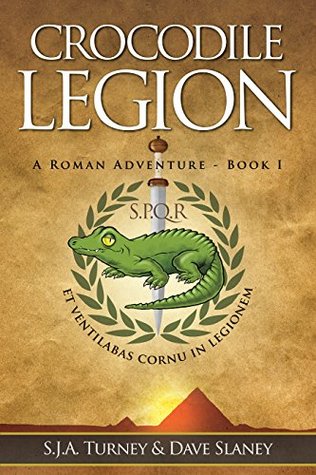
Crocodile Legion: A Roman Adventure by S.J.A. Turney – Review

Title – Crocodile Legion: A Roman Adventure
Author – S.J.A. Turney (Author), Dave Slaney (Illustrator)
Genre –  Historical Fiction/Young Adult
Length –   133 Pages
Publication – March 2016
My Rating – 5/5 Stars

Synopsis 

The prefect of Egypt needs money. And the men of the 22nd Legion must brave mazes and tombs and curses and crocodile gods to get to it.

Marcus and Callie, orphaned in ancient Alexandria and taken in by their uncle, the standard bearer in the legion, are about to travel up the great river Nile with the legionaries in a tense and funny adventure to grab the gold of the Pharaoh Amenemhat.

Join the legion and discover ancient Roman Egypt.

Review

S.J.A Turney is well known to me as a historical fiction writer. After reviewing some of his previous books I couldn’t wait to see how he would write a story aimed at a younger audience.

I couldn’t help but enjoy this tale, it had the historical edge Simon is known for but with the added fun that comes from being written for a young adult.

This story was enjoyable from the start; the young kids give a fun feel to the story as we see it through their eyes rather than the adults.

The storyline itself was great, I won’t spoil it but there’s a brilliant twist that I didn’t see coming

I know myself growing up when I struggled to read, because of my eyesight and through my own laziness that I found pages full of words a bit daunting.. My only comment I would make is that maybe I would have broken down the chapters into smaller chucks within the chapter so when you flick through there are plenty of places to pause..That’s just my preference though.. I can honestly say I loved the book.

The story was well written, everything made sense and I wasn’t left with any burning questions.. Exactly what I want from a book like this.

Added to Turney’s wonderful story telling we have the added Illustrations from Dave Slaney which brought a smile to my face whenever they popped up. More of these please.. they were brilliant!

One of the best things about the book is simply Turney’s writing. He’s managed to write a brilliantly fun story without removing what I know him best for, the descriptive details, the character development.. It’s all still there.. it’s an adult story but just told in a different manner..

Add this one to your TBR piles!

To find out more head to Goodreads, Amazon.co.uk or Amazon.com

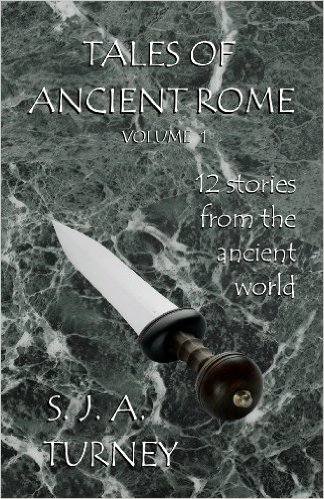
Tales of Ancient Rome by S.J.A. Turney – Review

Title – Tales of Ancient Rome
Author – S.J.A. Turney
Genre –  Historical Fiction/Short Stories
Length –  99 Pages
Publication –  Nov 2011
My Rating –  5/5 Stars

Synopsis

A collection of bite-size stories of varying styles all based in the world of ancient Rome. 12 tales of the ancient world, plus a bonus tale to finish.

The second edition contains two new tales not told in the 1st. Laugh, cry and shudder at:

Hold The Wall – Hadrian’s wall in the last days of the western empire
Vigil – A comedic tale of firefighting in Rome
*NEW* Rudis – A champion gladiator fights his last fight
*NEW* The Discovery – A Roman trader makes a surprising find in distant China
The man who bought an Empire – The lowest point of Imperial succession
Trackside seats – A slave helps his blind master at the circus
How to run a latifundium – A cautionary tale of estate management
A Reading – What does the future hold in Judea?
Exploratores – Trajan’s scouts on the trail of Dacian warriors
With a pinch of salt – A comedic tale of food in Claudius’ Rome
The Palmyrene Prince – Rome’s eastern border tells grim tales
Temple Trouble – A tale of the early days of Fronto (of the Marius’ Mules series)
Bonus tale: Aftermath in the Ludus – A fun finish.

Review

Yes I’m late to the party on this one I know…

As a reader I promise myself to go back and read all the books an author has wrote if I enjoy their work. It’s not always easy to fit all these wonderful tales in though..This however was perfect. I’ve been meaning to read more of Simon’s work and this was a easy read to stick in between other reads

It’s a collect of short stories which show off the author’s skills. It’s perfect if like me you want a quick read or this would also suit anyone as a great introduction to the author if you’ve not read his work previously

Some short stories leave me deflated, not bored but sort of wondering what I got out of reading them.. not this one. On numerous occasions I found myself grinning, especially when I read the sentence “oh dear, I think I shat myself” . This really was a selection of well written shorts which at times were very humorous which I think is a hard thing to do in such short tales.

My favourites were Temple Trouble & The Discovery

The book is currently free so why not grab a copy like I did.. you’ve got nothing to lose but lots to gain 🙂

To find out more head to Goodreads, Amazon.co.uk or Amazon.com

Cover design and it’s importance – Guest post by author C.R. May

Today i bring to you a guest post from author C.R. May. Cliff will talk about covers and their importance . You may remember recently i posted a review of one of his books Fire & Steel. Covers are so important to me and play a big part in deciding what books i buy. Cliff i must say has some awesome covers which definitely catch the eye and draw a reader in.

I hope you find his take on covers as interesting as i have.

Without further ado..take it away Cliff.


This is a tale (cautionary if you are a new or aspiring author) about the very first thing which draws us to a book which is, of course, the cover.

As a first-time author I looked forward to the cover design part of the writing process; it must be easier than writing a novel, right? If only that were true. The simple fact is that if you are an independently published author the whole shebang, research, planning, writing, re-writing, editing, cover design, promotion etc, is entirely in your hands. Of course there are a myriad number of professionals out there willing to help you out for a fee, but it is a truism of writing today that the cottage industry of editors, proofreaders, and cover designers which has grown to satisfy this demand often make far more money from the business than the people who write the books themselves. A professionally produced cover can easily cost four figures. What if, like the vast majority of self published books, your surefire bestseller actually sank like a stone? Amazon alone publish thousands of new titles each and every day and even at a very reasonable £1.99 a go, the author actually receives not much more than £1 per download. For a physical copy the profit margins can be even worse. The production costs for a print-on-demand publisher like Amazon’s Createspace will produce an average sized paperback containing around 100,000 words for about £8. If the author adds just £1 to that for their own profit he or she will still be priced out of the market by the big boys. I once saw Tesco selling Ben Kane’s latest hardback bundled with his previous volume for £6. Paperbacks in the big supermarkets are typically £3, or two for £5.

So it can be tough out there, your cover has to grab a potential reader’s attention straight away. Let’s see how my own cover developed over time using my very first book, Sorrow Hill, as an example. The story starts off with young Beowulf poaching two eagle chicks from the nest so, after spending days groaning over jokey or just plain ridiculous ‘Viking’ pictures on photo sites such as Shutterstock, Getty Images etc I gave up with that angle. Anglo-Saxon was even worse, pictures of Big Ben, red post boxes or Union Jack knickers seemed to be about all that they had to represent one of the most advanced cultures in early medieval Europe. Beowulf? Angelina Jolie of course. So back to the eagles it had to be. This is my first design from back in 2013.
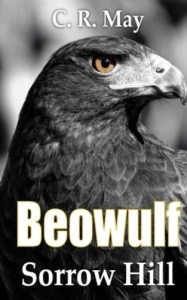
1

A nice image, monochrome to be ‘different’ – (before I discovered that most readers don’t do ‘different’). If they are interested in Roman literature they expect to see a Centurion or legionary standard on the cover; Dark Ages, longship/swordsman.  Even before book two had appeared I decided that if I wanted affordable originality, I would have to make my own.

I have a statue of Odin/Woden which is a copy of an original in the Swedish National Museum Stockholm. By placing this onto a picture of a pattern-wielded sword (and supporting the head on a ball of blu-tack!) I developed a common look to the series which also reflected the series title, Sword of Woden. Delving into the various fonts and script types which you can find on most computers gave me this…
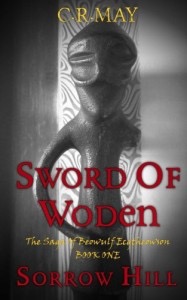
2

Although this image looked far better, and certainly easier to develop into a series, at a smaller scale it quickly became apparent that it was not much more than a red and yellow blob and far too dark when viewed on an e-reader or mobile phone screen so… A bit more proficient by now, I stripped off the script and increased the shading before adding gold and white lettering. The darker lower third helped with the clarity of the title, and thus was born Sorrow Hill – mark 3:
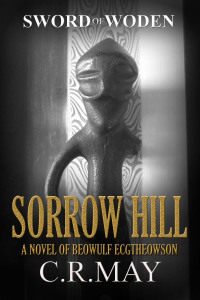
3

Not convinced? No, neither was I, so back to the eagle it went, this time using an image which I had taken at Battery Park in New York City with my trusty Canon IXUS.
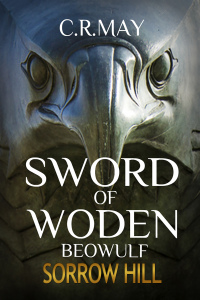
4

It’s a nice cover, and it might have remained that way if the book had not done too well. Fortunately not only did it seem that I could spin a good yarn after all, but others seemed to agree. As word spread and the Sword of Woden series was followed by the equally well received Brennus, Conqueror of Rome series of books, it became obvious that my homemade covers were just not up to scratch. With an established readership and more confident now in my ability to sell books on a consistent basis, this year I finally took the leap of faith and began to commission professional covers…
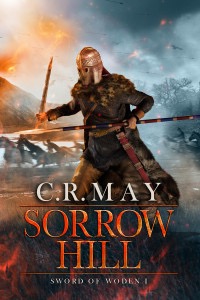
5

The Sword of Woden trilogy, being the early life story of the legendary figure Beowulf, necessarily contained a few supernatural elements. One of the minor characters who appeared in books one and three, the Angle, Eofer, is now the subject of my latest series, King’s Bane, which tells the story of the Anglian migration from present day Jutland to the lands which would in time become England. By using the same cover designer for both series of books and writing a novella, Dayraven, to link the two storylines, I have left the myth and legend element of the Beowulf tale behind and grounded the events more firmly within the  history of early sixth Century Europe. Utilising the same designer for the Sword of Woden and King’s Bane series’ means that I can finally obtain the homogenous look which I have strived for over the past few years, while injecting a greater degree of action into the cover images. Here is the cover for the first book of the King’s Bane series, Fire & Steel to illustrate the point.
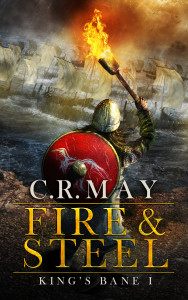
6.jpg

I think that we all agree that it is an unfortunate part of book buying that a book really is judged initially by its cover. However good an author’s work, he or she has not much more than a second for their thumbnail sized image to spark an interest in the potential reader from among dozens of others. Even though the book has been available and selling steadily for three years now, the new cover for Sorrow Hill has led to a spike in sales and increased traffic to my website. Every one of the various stages which a novel undergoes from the initial idea in the author’s mind to completed book is important, but the cover art really is vital to its success.

Similarly, the addition of good quality maps can really help to lift your book above the competition, especially in these days of ‘look inside’ features on e-book websites. My first books had no maps at all, and several readers were good enough to contact me via the link on my website to suggest that they would really help to understand the storyline. As my books are all set in the ancient past, most of the names used are either in their archaic form, Hroar’s Kilde for present day Roskilde for example, or even based on educated guesswork as in Sleyswic for present day Schleswig.

My first maps were similar efforts to the cover designs which I made at the same time, best described as helpful rather than artwork. This is an example of my first maps, in this case the map which accompanied the concluding volume of my Brennus series, Nemesis.
7

As you can see the information is all there and it’s not the worst map that I have ever seen in a book, but it’s obviously homemade and has no ‘wow’ factor. Here is the new map which replaced it:
8

All of my books now contain maps of this quality, hand drawn by the same artist Simon Walpole who will also draw the maps in my future books. This will help lend a feeling of continuity and familiarity, reenforcing the effect of the similar cover designs.

Covers and, thanks to the ability to look inside or even download samples of ebooks in moments, maps, really do give a book the best chance of success and are an essential investment for any novelist.

To connect with Cliff head to the author’s website or Twitter. You may also like to view his author page on Goodreads, Amazon.co.uk or Amazon.com

From One Sentence to a Full Manuscript: How Novels are Born – Annie Whitehead

Today i open my blog to Annie Whitehead! author of the amazing To Be a Queen and Alvar the Kingmaker. Both books I’ve recently reviewed and enjoyed immensely  🙂

Thanks Annie.. myself and my readers appreciate you taking the time to be here with us.

My blog is all yours…

IMG_20160321_113455

Apart from the odd foray into fantasy fiction (Fattypuffs and Thinifers by André Maurois – although I notice now that apart from it being incredibly non-PC, it has historical costumes) I only ever read historical fiction when I was a child. I wasn’t a quick or voracious reader, so I really think it was the tales of history being brought to life which appealed to me, rather than the literature. But I also wrote my own stories (about Ferdinand the Hedgehog!) so I guess the desire to write was always there, and at some point the desire to write, and the desire to write history, coincided.

While history remained my first love, the literature thing continued to burgeon – I studied both subjects for ‘A’ level and was all set to read English at university when I switched and read history instead. My first two historical novels both came about because of a single sentence. In the case of To Be a Queen, the story of Alfred the Great’s daughter Aethelflaed, it was a sentence about her husband. My tutor said of Ethelred of Mercia that “Nobody knew exactly where he came from.” I suddenly had a vision of this guy riding onto the pages of history out of some unknown hinterland. I wanted to write his story and, in a way, I have. Although of course the real story was that of his wife: daughter of a king, wife of a man with the powers of a king (albeit a sub-king); a woman who led her army into battle against the Vikings.

Queen promo

My second novel was born when I read a paper written by that same tutor. It was about Aelfhere, earl of Mercia in the 10th century, and in a little footnote there was mention of a widow who had been deprived of her lands following his death. It’s the only known reference to this woman and the supposition is that she was Aelfhere’s wife. Hmm… Why did we not know more about her? This became part, although not the whole, of the story in Alvar the Kingmaker. A central theme, yes, but there was more which needed to be told. I wanted to write his story, but never as a thesis, or a non-fiction book. I suppose I wanted the element of ‘romance’, in its broadest term.

Alvarpromo

So how does one go about constructing an historical novel?

I had my ambition to write. I had my stories. And I knew my stuff. Ask me the names of any king between AD600 – 1066  and I could oblige. Ask me who invaded whose lands at any given period and why, and I could tell you.

Just one problem. I quickly discovered that I didn’t know how people lived; what they ate for breakfast, what they wore, how they built their houses and ships, which animals they reared and what type of crops they farmed.

It’s all very well having a chapter plan but not so great if you can’t actually describe what’s happening in every scene. I learned that knowing about history and having the information required to write an historical novel are not the same thing. Turns out that it was the literature, as well as the history, that had made those stories so interesting for me when I was young.

I also learned that it’s sometimes better to write the story and then only stop when you need to look up some historical detail – it keeps it human and personal if you concentrate on your characters and story. I know I’m not the only author who will draft sentences like this: ‘The table was laid with plates of check seasonal foods’ or ‘The children were waist-deep in the river, fishing for check types of freshwater fish later.’

Luckily for me, I had contacts within the ‘industry’ who were more than happy to help, or knew someone who could. I immersed myself in my early medieval world, finding out about looms, textiles, cooking methods, flour production, and I even learned how flammable flour dust can be (a fact which served me well in one particular passage in ‘Queen’.)

Debby

But research isn’t the only thing required: you have to decide your story. It can’t simply be a narrative of what is known to have happened, otherwise it will read like an essay. But stray too far from the facts and you might as well just write pure fiction. Do you tell the whole of a person’s life, and end when they die, or do you focus on a particular period of history? Yes, you have your timeline already worked out, but where along that line do you start and stop?

Sometimes there are gaps in that timeline, and that’s where the fun can be had. You wonder ‘What if?’ And if the answer is ‘Nobody knows’ then you’re free to let your imagination fly. Sometimes you then unearth a scrap of evidence that gives credence to your idea – what’s known in the trade as a  ‘Bingo’ moment.

You also need to make your characters out of the chronicles and mould them into people. Carefully. My characters are not the Anglo-Saxons of Middle Earth. They are not mystical, magical or mythical, but rather they are medieval. My stories don’t contain elves or monsters. The ‘Dark Ages’ covers a period of over 500 years. To lump all the Anglo-Saxons together would be like saying the Tudors were a lot like us.

Alvar lives in a period of relative peace. People have a breathing space between Viking attacks to find out who they are, what their values are. ‘England’ is a reality and yet still only a concept to many. It’s a Christian world where people cling to superstition, too. It’s important not to place modern values on your characters – they need to live and work in their own world. Aethelflaed is a strong-minded woman, yes, but in writing her, I needed to keep her firmly rooted in her early medieval environment. She’s a woman in a man’s world, but she’s not what we would recognise as a feminist.

A sense of place, a sense of time. For me, the art of writing an historical novel is a subtle blend, requiring equal measures of: the story, the characters, the history, and the details. When the blend is right, it should be possible to have the reader not just dip into it, but  become fully submerged without those precious parts separating at any point.

Thanks Annie!

To keep in touch with Annie check out her Blog, Twitter, Facebook, or Annie’s Author page on Amazon.co.uk or Amazon.com 🙂